What's new

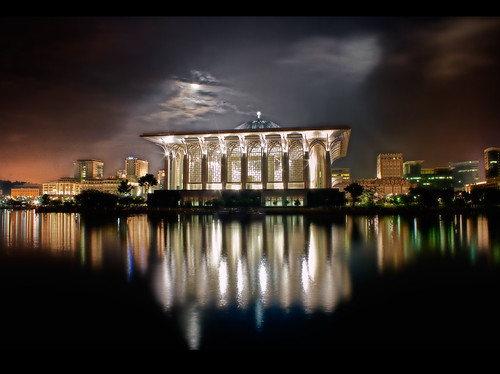
Super Moon

Yep, it was a moon.

img3906a.jpg
 
Chito Beach, I like the crater detail you achieved on the top edge. What settings and lens did you use?
 
My feelings: Moon is nearly spherical; but we see it as a circular disc. The 11% increase in size means 11% increase in area we see.. We know area= pi x r^2. ; so 11= pi x r^2; so r= 2.1 nearly
So radius has increased by nearly 2% and in that case diameter has increased by 4% only; so how can there be a visible increase in size, i wonder.

Even though we see moon as a disc actually we see a hemisphere. the surface area of a hemi sphere is 2xpix r^2
since radius has increased nearly by 2.15 %, the area has increased by 2 x pi x 2.15x 2.15= 30 percent, approx.; Again the increase in the hemi spherical area is visually compressed to a disc and so there is going to be an additional increase in the glow.

These are contributing factors only ;)

Approximately yours :lol:
 
What you see is a disc, but it has another measurement..... angular size. In other words, from your standpoint, how would you measure it in degrees, arcminutes and arcseconds?

As photographers, we're all aware of perspective, and how things 'appear' smaller the further away they are. The moon doesn't actually get any larger. It's diameter is still the same. It is just closer to use, so it appears larger (measured angularly) to us earthlings.

At it's furthest point, the moon is 29.3 arcminutes. At it's closest, it's 34.1 arcminutes. This is where the "30% larger" claim comes from, although that figure isn't accurate either. 34.1 is only 16.4% 'larger' than 29.3. 29.3 + (29.3 * .164).
 
Good going; by the way, i made a mistake; if radius is +2%, diameter is also +2%

PS: i did not say moon is actually getting bigger; i was mentioning the apparent growth, not the actual The arc minutes increase just because the apparent diameter increase
:D
 
All this logic and evidence stuff takes the fun out of it. I'd rather tell people that the moon is swelling because it got an infection when we shot that rocket at it last year.
 
It's bigger and brighter cuz jtee handheld the shot and he's bigger than me..............USM IS
 
"14% larger"?

I call shenanigans on this. The moon's orbit is ellipitcal, varying between 363,104 and 405,696 km. That's 11.7% at best, and only a paltry 5.8% from it's semi-major axis (average distance).

"30% brighter"?

How? It's still 150,000 km from it's source of illumination.... the sun. Earth does not illuminate a full moon. It can't because it's facing the night side of the planet. If anything, it's brighter during the phase we call New Moon, because it's closer to the sun then.

I hate raining on your parade, but them's the facts.

Maybe you should share your theories with NASA. :eyebrows:

Super Full Moon - NASA Science

movie_strip.jpg

Above: Perigee moons are as much as 14% wider and 30% brighter than lesser full Moons

 
Last edited by a moderator:
"14% larger"?

I call shenanigans on this. The moon's orbit is ellipitcal, varying between 363,104 and 405,696 km. That's 11.7% at best, and only a paltry 5.8% from it's semi-major axis (average distance).

"30% brighter"?

How? It's still 150,000 km from it's source of illumination.... the sun. Earth does not illuminate a full moon. It can't because it's facing the night side of the planet. If anything, it's brighter during the phase we call New Moon, because it's closer to the sun then.

I hate raining on your parade, but them's the facts.

Maybe you should share your theories with NASA. :eyebrows:

Super Full Moon - NASA Science

movie_strip.jpg

Above: Perigee moons are as much as 14% wider and 30% brighter than lesser full Moons


That nullifies all my suggestions and sublimates all speculations :thumbsup:
 
Last edited by a moderator:

Create an account or login to comment

You must be a member in order to leave a comment

Create account

Create an account on our community. It's easy!

Log in

Already have an account? Log in here.

Back
Top Bottom