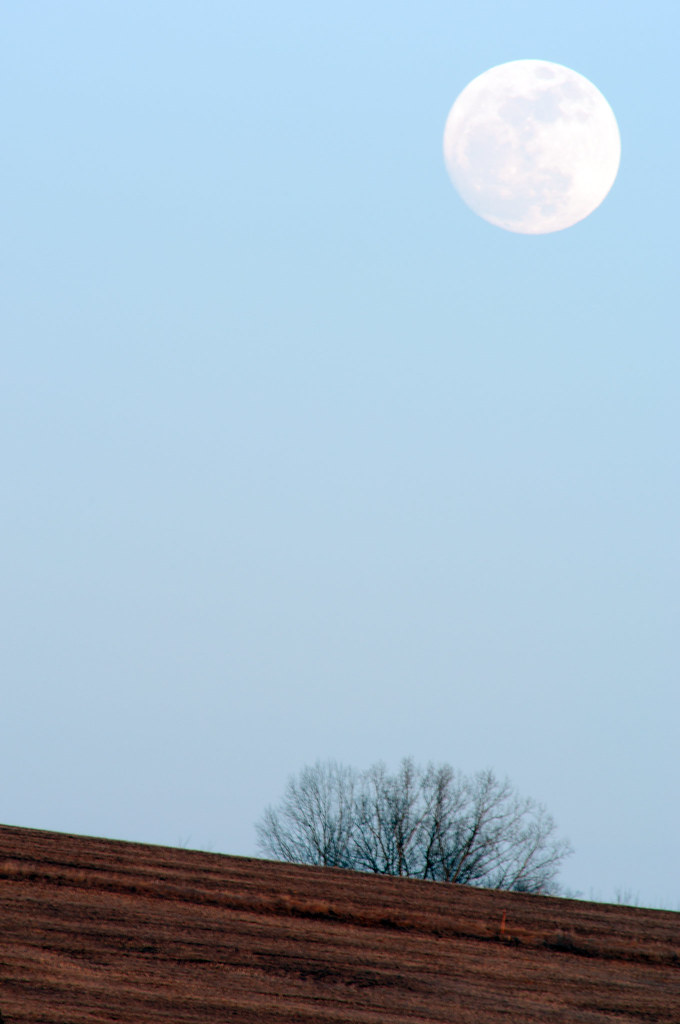
Above: Perigee moons are as much as 14% wider and 30% brighter than lesser full Moons
These tell me that this was yet another astronomical story that was only
partially reported by the media, which leads to misinformation.
What NASA says: a full moon at perigee (it's closest point to Earth) appears 14% bigger and 30% brighter
than a full moon at apogee (it's farthest point from Earth).
What the media says: the super moon will appear 14% bigger and 30% brighter.
What the public assumes: the super moon will appear 14% bigger and 30% brighter
than normal.
There's a big difference between the first statement and the last. Not every full moon occurs at apogee either (in fact,
the next full moon at apogee won't be until October). So while the media's statements are partially true, they're leaving off some crucial bits of information that make people misunderstand the facts.
Also, in regards to the comments earlier about the moon not changing brightness - there's a difference between photographic brightness and astronomical brightness. When they say the moon will be 30% brighter they're not talking about its reflectivity; they're talking about it's
apparent brightness, just like they're talking about
apparent size. If you take a desk lamp and use it to light a scene, and then move that lamp closer to your subject, the lamp will not have changed brightness, but you will also need less exposure on your subject because the light will appear to be brighter to that subject (inverse square law). Same principle. Astronomical objects are measured on a magnitude scale that have to do with how we see them, not what their actual brightness is.
This reminds me a little bit of the email hoax that went around a few years ago that said that Mars was going to be the closest to Earth it had been in years, and that it would look as big as the full moon to the naked eye. At least, that's what people
thought it said. What it
actually said was that it would be the same apparent diameter
through a small telescope as the moon is to the naked eye. Sometimes people hear what they want to hear.




 .........