What's new

Upgrading.... Canon or Nikon?

Yes and at 25,600 it's almost a whole stop. At 51,200 and 104,400, only one of the cameras will even take a picture (would be about 1.5 stops for both if you extrapolate the line from Nikon down to where it would be if these were offered)

The average difference over the entire range of ISOs is very close to zero, with one specializing in low ISOs, and the other in high ISOs.


In actual practice, it often doesn't really matter much even then, though (specialized situations). For instance:
* Landscapes: you already have little time pressure, and usually a tripod or stable setup. So you could just use HDR anyway and get 20+ stops of dynamic range with either camera in a fraction of a second taking only 2 photos. Meaning the Nikon advantage is not too important there.
* Same thing goes for lots of nighttime street shots. Meaning the Canon advantage is not too important there, either.

The only times I can think of where it really does matter and there's no way around it is:
1) Studio portraiture: you can't do HDR because the person will move slightly, so the Nikon has a real edge.
2) Sports: You can't do HDR for the same reason, so the Canon has a real edge.

But EVEN THEN, in a studio you can just adjust the lights to not have a huge dynamic range in the first place (problem solved!) and in sports, it would be rare to be shooting at 52,000 ISO or whatever.

So overall, TL;DR: Meh. Rarely will matter.
 
The thing you seem to be missing about dynamic range is pretty simple. The dynamic range advantage that the Sony sensors have over the sensors made by Canon lies in how noisy the shadows are in the Canon cameras, and how very EASILY they show noise when the shadows are "lifted" in post processing. The need for this shadow "lifting" is due to the narrower range of highlight values possible to capture. Sorry Gavjenks, but the better dynamic range AND the better color depth the SOny-sensored cameras have is indicative of something "under the hood", where you just seem to miss seeing the fundamental reason that a sensor with wider DR AND richer color is--a better sensor. Fundamentally. I'm surprised that a smart guy like you is so clueless as to WHY the DR is better, and why the color depth and richness is simply better in Sony-made sensors than what Canon's been limping along with.

Basically, Canon's still got a serious problem, even in its BEST sensor...Canon STILL has patterned banding AND noise in shadows at Base ISO--even on their BEST sensor!!!

Part II - Controlled tests

Sony's sensor's on the other hand..well, let's allow Fred Miranda himself, KING of the landscape site webmasters, tell it in his own words...

"It's no secret that the Canon 5D Mark II does not have the cleanest shadows even at base ISO 100. It's usually unnoticeable in good light if we don't start pushing it in post. However, even perfectly exposed shots in high contrast lighting will show, color and luma noise in the shadows when pushed one or two stops in software. To make matters worse, you might even find some banding or visible horizontal and vertical line patterns. At this point, I was wondering how the 5D Mark III and D800 would deal with noise at base ISO. Canon shooters brace yourselves because I don't have good news."

and "Although the Canon 5D Mark III deals with banding slightly better than the previous version, surprisingly I could still see a substantial amount of color noise.Obviously, the Nikon D800 is in a totally different league. Absent of color noise or any pattern, this image reveals Nikon's exceptional performance.

And "The Mark III image shows a huge chunk of color noise. Vertical patterns are also visible.There is no question that the D800 does not disappoint in signal to noise ratio (SNR) at low ISO and has higher dynamic range. I'm still shocked by the differences."

"In regards to the Nikon D800 handing of noise in the shadow areas, I have to say it's nothing short of amazing! Kudos to Sony and Nikon for the new sensor partnership. The Exmor sensor is exceptional and there is so much detail in the shadows. I can push the shadows more than 4 stops without any hint of color noise. WOW! Let's just say the D800 sensor is a breakthrough in sensor technology."

Older, outdated Canon sensor technology, versus newer, better Sony sensor technology.

 
1) The 5D Mk III us not Canon's best sensor.
2) None of that is remotely relevant if you are in a situation where you can do HDR (like landscapes, architecture, etc.)
3) The author of your article does a terrible job of explaining any actual variables. No mention of ISO or any settings on any of those photos, no mention of whether they are even RAW or JPEG. No mention of how exactly he went about adjusting for shadows (other than he "used lightroom"). This is not information that should be valued in the same league as DxO Mark, or if you prefer looking at pictures, more competent and informative photo examples like those from dpreview:

The dynamic range advantage that the Sony sensors have over the sensors made by Canon lies in how noisy the shadows are in the Canon cameras
This is your claim. Let's take a look:

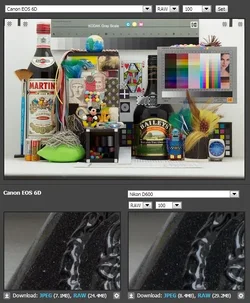
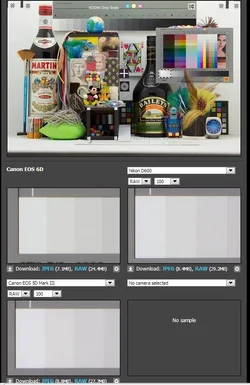
6D (better sensor than 5DIII for less money) vs. D600 at ISO 100, RAW, each shot with 50mm 1.4 lenses. No obvious difference in the shadow noise whatsoever, consistent with the findings at DxO Mark.
$100.webp

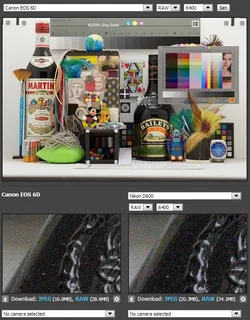
At ISO 6400, not much obvious difference in the shadows along any dimension:
$6400.webp

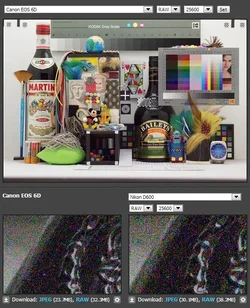
At ISO 25,600, difference becomes noticeable with less noise in Canon, slightly. Again, consistent with the numbers from DxO Mark.

$25600.webp

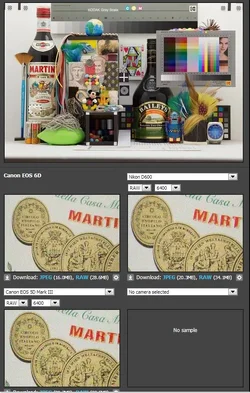
And here's one with the 5DIII thrown in, looking at text readability (the first point in that guy's article) that does not support his conclusions at all. This is, however, consistent with the numbers from DxO Mark yet again.
$text.webp


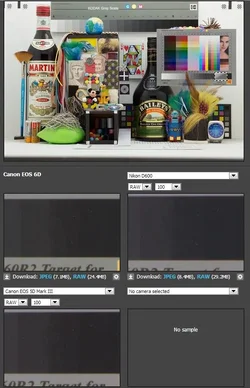
And some shots of the light and dark ends of a lightness scale, at the famed ISO 100. No matter how much I squint, I don't see any substantially better definition between values in any of the cameras:

$light.webp
$dark.webp


So when exactly does any of this really make a big difference, again?

Conclusion still = Meh.
 
Last edited:
Ken Rockwell has some really odd hangups about brands. the amount he harps on about number of aperture blades across articles for instance boggles the mind.
 
Thank you for all your feedback,
In the end I definitely want to have a camera that I really enjoy and have fun with.
Yes underwater photography is my absolute passion, but not limited too as I am exploring a lot still and enjoying lots of different photography. I have been looking at the Ikelite underwater housings, I'd probably get something American either way because the Aussie underwater housing prices are through the roof, from what I have found. Like three or four times the amount of American products!
I like the look of the 70D, but how long would I have to wait for underwater housing to come out for this model - is it worth it? I still will be waiting a few months after my new camera, to be able to afford the housing.
I am considering holding off from the full framing this round, due to costs.
 
A 6D costs about $1500 in a kit.
A 70D costs about $1200 in a kit.

In my opinion buying a 70D "due to costs" is just crazy at that difference. You should get it IF you care about video and video focusing. That is its strength (and to a lesser extent fancy still autofocus and FPS like the 7D). It's a somewhat sports and mostly video oriented camera.

If those aren't your main interests, then the advantages of full frame (and the options and ergonomics and custom modes etc. etc. that come with it) for just $300 more are massively more bang for your buck. 11% more money (with housings), for easily 50-75% more satisfying usage experience in my opinion.
 
A 6D costs about $1500 in a kit.
A 70D costs about $1200 in a kit.

A 70D does cost $1200, but a 6D here costs about $2200, so add another thousand onto that price :\
I think I may be able to get slightly cheaper if I shop online so in the end I guess its going to come down to how much video I'll probably use!
 
All in all though, I think I am going to go the stretch and get full frame photography.
 
Hi Britt,

one thing no-one seems to mention is that when you buy an SLR, you tend to stick with that brand for life:) I suggest that you have a play with some of the major brands and see how easy you find the firmware to play with. I'm a Canon guy, just because I'm familiar with the way they work. I'll stick with canon because I have a small fortune invested in lenses so even if the N brand came out with the perfect SLR, I'll stay loyal to Canon:)

For underwater work, I'd go for a compact, but thats just me

(P.S. I'm in Brisbane, so if your close by your more than welcome to have a play with my Canon)

Shane
 
Ken Rockwell has some really odd hangups about brands. the amount he harps on about number of aperture blades across articles for instance boggles the mind.

Ken Rockwell boggles everyone's minds. It isn't just you. I go to his site when I'm bored or need a good laugh.
 
A 6D costs about $1500 in a kit.
A 70D costs about $1200 in a kit.

A 70D does cost $1200, but a 6D here costs about $2200, so add another thousand onto that price :\
I think I may be able to get slightly cheaper if I shop online so in the end I guess its going to come down to how much video I'll probably use!
Are you sure you're looking at it IN A KIT?

A 6D body alone also costs around $2000+ in the states. But when you get it in a kit along with a 24-105L lens, the total price is about $2200. That lens sells used on ebay for approximately $800 as we speak, and new it costs much more than that. So even if you don't want the lens, you'd buy the kit, sell the lens for $800, and you're left with a camera that costs $1600 total.

Possible $1500 if you get on the upper end for your lens, or if you keep it and value it as more than $800.
 
Hi Britt,

one thing no-one seems to mention is that when you buy an SLR, you tend to stick with that brand for life:) I suggest that you have a play with some of the major brands and see how easy you find the firmware to play with. I'm a Canon guy, just because I'm familiar with the way they work. I'll stick with canon because I have a small fortune invested in lenses so even if the N brand came out with the perfect SLR, I'll stay loyal to Canon:)

For underwater work, I'd go for a compact, but thats just me

(P.S. I'm in Brisbane, so if your close by your more than welcome to have a play with my Canon)

Shane

Hi Shane,

I currently have a canon that I love and I'd prefer to stay with Canon, but I wanted to explore all options to see what best suited me.
I would of loved to have a look at your Canon, but I'm in Western Australia!
With the compact idea, I'll be using my camera for more than underwater and want to be that little bit more set up for particular shots :)
I will probably stay Canon, I really like the set up.

Thanks for your feedback!
 
A 6D costs about $1500 in a kit.
A 70D costs about $1200 in a kit.

A 70D does cost $1200, but a 6D here costs about $2200, so add another thousand onto that price :\
I think I may be able to get slightly cheaper if I shop online so in the end I guess its going to come down to how much video I'll probably use!
Are you sure you're looking at it IN A KIT?

A 6D body alone also costs around $2000+ in the states. But when you get it in a kit along with a 24-105L lens, the total price is about $2200. That lens sells used on ebay for approximately $800 as we speak, and new it costs much more than that. So even if you don't want the lens, you'd buy the kit, sell the lens for $800, and you're left with a camera that costs $1600 total.

Possible $1500 if you get on the upper end for your lens, or if you keep it and value it as more than $800.

Ohh I see what you mean! From what I can see online the kits here are two and a half grand plus. It probably would be a good idea
 

Create an account or login to comment

You must be a member in order to leave a comment

Create account

Create an account on our community. It's easy!

Log in

Already have an account? Log in here.

Back
Top Bottom