When
not using strobed light (flash) the 3 exposure controls - shutter speed, lens aperture, ISO - all control the exposure. Additionally, shutter speed controls motion stopping, aperture controls depth-of-field (DoF), and ISO controls image noise.
When using strobed light (flash), the ISO setting you use is tailored to the flash unit power setting, but like in an available light exposure is set to as low a value as possible based on the flash unit power setting.
When using strobed light (flash), shutter speed is no longer used to control motion stopping. The short duration of the flash of light does that instead.
Shutter speed is then used to control the ambient light exposure.
When using strobed light (flash), the lens aperture still controls DoF, but it also controls the strobed light exposure.
In summary, when using strobed light (flash), you control
2 exposures with a single shutter release, 1 for the ambient light (shutter speed), and the second for the strobed light (flash) (lens aperture + flash unit power setting).
Note: Inverse-square law - Wikipedia, the free encyclopedia
The Inverse Square Law says that as light source distance from the subject changes, the light power changes as a square function.
In other words, if the light source is moved 2 times
further away from a subject, the amount of light delivered to the subject is reduced to 1/4 as much. If the light source is moved 2 times
closer to a subject, the amount of light delivered to the subject is 4x as much.
By the same reasoning, if the light source is moved
4 times
further away from a subject, the amount of light delivered to the subject is reduced to 1/16 as much.
If the light source is moved 4 times
closer to a subject, the amount of light delivered to the subject is 16x as much.


 #1 #2
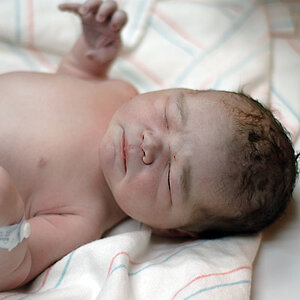
#1 #2 This is my youngest son... Only used PSE11 to resize the photo so I could upload on here... No other edits done