What's new

Friday Night Moon Shots

Its ok, no worries
 
You can't get decent results but aiming a lens at the moon and triggering the shutter.. Stack a 1 stop and a 2 stop ND filter in front of your glass. Use a 400 with a doubler, manual focus, fire some frames. You get the picture.. There is one I shot of the moon tonight on my blog.

the Iconic Image

There is absolutely NO reason to put any type of filter in front of your lens when shooting the moon. If your shot is overexposed, shorten the exposure time. The moon is never any brighter than an earth scene in the middle of the day. They are both lit by the sun and are both the same distance from said sun.

Some basics:
Get the longest lens you have. Sometimes a slightly shorter focal length prime is sharper than a longer zoom, so keep this in mind. Experiment.

Set the aperture to its sharpest setting (usually 2 stops slower than wide open).

Depending on how sharp your lens is, you can put a teleconverter on it too. Keep in mind this greatly reduces the light and sharpness, so if you can already see the softness of your lens at max zoom, there's no reason to amplify the softness with the teleconverter.

Now choose ISO and shutter speed. It's somewhat of a balancing act if you're handholding the shot, but if it's a tripod shot and you have some kind of remote, timer, and/or mirror lock up, then go with ISO 100 and adjust shutter speed accordingly. If handheld, make sure your shutter speed isn't slower than 1/F.L. In other words if you have a 300mm lens, shutter speed shouldn't be slower than 1/300th of a second. Adjust ISO accordingly.

It's very basic stuff with exposure. If you have a white ball, it's overexposed. If you have a black screen, it's underexposed. The histogram is your friend, but it's easy to see visually too.

It's best to shoot the moon when it's at least 45 degrees above the horizon - less atmosphere to shoot through and therefore less risk of distortion at higher focal lengths. Happy shooting.

 
You can't get decent results but aiming a lens at the moon and triggering the shutter.. Stack a 1 stop and a 2 stop ND filter in front of your glass. Use a 400 with a doubler, manual focus, fire some frames. You get the picture.. There is one I shot of the moon tonight on my blog.

the Iconic Image

There is absolutely NO reason to put any type of filter in front of your lens when shooting the moon. If your shot is overexposed, shorten the exposure time. The moon is never any brighter than an earth scene in the middle of the day. They are both lit by the sun and are both the same distance from said sun.

Some basics:
Get the longest lens you have. Sometimes a slightly shorter focal length prime is sharper than a longer zoom, so keep this in mind. Experiment.

Set the aperture to its sharpest setting (usually 2 stops slower than wide open).

Depending on how sharp your lens is, you can put a teleconverter on it too. Keep in mind this greatly reduces the light and sharpness, so if you can already see the softness of your lens at max zoom, there's no reason to amplify the softness with the teleconverter.

Now choose ISO and shutter speed. It's somewhat of a balancing act if you're handholding the shot, but if it's a tripod shot and you have some kind of remote, timer, and/or mirror lock up, then go with ISO 100 and adjust shutter speed accordingly. If handheld, make sure your shutter speed isn't slower than 1/F.L. In other words if you have a 300mm lens, shutter speed shouldn't be slower than 1/300th of a second. Adjust ISO accordingly.

It's very basic stuff with exposure. If you have a white ball, it's overexposed. If you have a black screen, it's underexposed. The histogram is your friend, but it's easy to see visually too.

It's best to shoot the moon when it's at least 45 degrees above the horizon - less atmosphere to shoot through and therefore less risk of distortion at higher focal lengths. Happy shooting.

i loaned out my 300mm, so ill have to give it a nother try with my 55-200mm. (hopefully thats enough :confused: ) Im gonna play with settings and work with it again.. i think tonight was supposed to be a full moon...( if the storm clouds dont swallow it whole that is..lol)
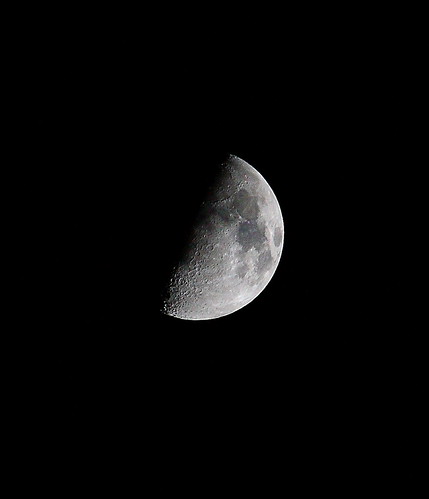
Thanks for the advice!:thumbup:
 
Taken with a Canon 55-250

4400648369_45fd01379b.jpg
 
I have not tried to capture the moon close up, but I've seen some good information to get me started.

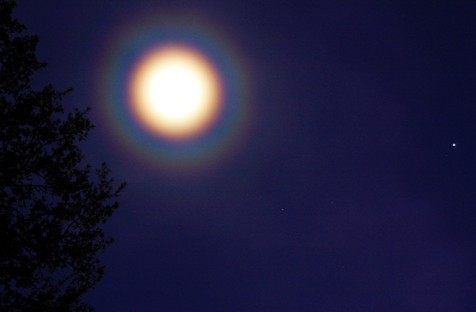
What I do have is a lunar corona, who's subtle colors were difficult to capture. Coronas are caused by tiny water droplets of similar size way up in the atmosphere. This one was particularly colorful. The star to the right is the planet Jupiter.

4402018914_1315da2c78.jpg


This image has a bit of lens flare, but it was one of my first attempts at dusk photography, showing the new moon:

4401331945_438c601b05_o.jpg
 
Last edited:
Apparently I left my memory card with the Friday Night Moon Shots at my friends house over the weekend. However, when I was driving home on Sunday, the moonrise was spectacular. I still had a 15 minute drive home when it began its ascent. After scramblng to get setup to still see it orange, I got this shot.


801319774_wD5yW-XL.jpg


Not the best, but something.​
 

Create an account or login to comment

You must be a member in order to leave a comment

Create account

Create an account on our community. It's easy!

Log in

Already have an account? Log in here.

New Topics

Back
Top Bottom