The moon is a very easy exposure. Your camera and lens are easily able to do this.
There's a simple exposure rule that helps you determine the correct exposure (because the camera's metering system will likely be fooled by the blackness of the surrounding sky). Use a Manual exposure mode ("M" on the dial.)
If you set the aperture value (aka "f-stop") to f/11 then the shutter speed is simply the inverse of the ISO setting.
So if you are using ISO 100, then the correct shutter speed (at f/11) would be 1/100th. If you use ISO 200 then the correct shutter speed would be 1/200th.
This relationship for the moon is called the "Looney 11 Rule" (see:
Looney 11 rule - Wikipedia ) You can find numerous articles on this.
You don't actually have to use f/11... but this is the only f-stop at which the shutter speed is simply the inverse of the ISO setting. So... suppose you want a faster shutter speed. You could shoot at f/8 (which doubles how much light passes through the lens as compared to what it would have collected at f/11) and that means that since you're getting twice as much light, you only need to expose for half as long. So at ISO 100 and f/8 you would use 1/200th sec instead of 1/100th sec. If you drop the f-stop down to f/5.6 (which doubles the light again) then you could take the shot at 1/400th sec.
The camera's focus system likely can achieve good focus on the moon (it's large enough and bright enough - particular if you focus just near the edge of the moon). Focusing on stars is much trickier because they aren't bright enough nor large enough for the focus system to work on them (it's always a manual focus task).
One more tip... if you shoot during (or near) the "full moon" then the moon has rather flat lighting. It looks like a 2-D disk without much interesting contrast. If you shoot nearer to the 1st Quarter moon when the light is hitting the sun from the side, then the lunar landscape produces shadows which really bring out the 3-D nature of the craters and mountains. It produces a much more interesting looking moon.
Here's a shot I took a couple of years ago. There's a story with this. I was at a monthly astronomy club "Beginner's Night" event with my scope and one of the guests was interested in learning how to take an exposure of the moon. I normally never do any astrophotography on a "Beginner's Night" because it's more of a visual-observing event when the public is present. But I just happened to have my camera with me.
I explained the process, I told the guest that no guessing is required... you can nail this exposure on your first try if you know the rule. So I dialed in the Looney 11 exposure of ISO 100 and 1/100th sec (the scope is an f/5.4 but I happened to be using a 2x teleconverter making it effectively f/11 (f/10.8 - close enough). We focused the camera, and I took just ONE exposure.
This is that one exposure: (again... no guessing needed)
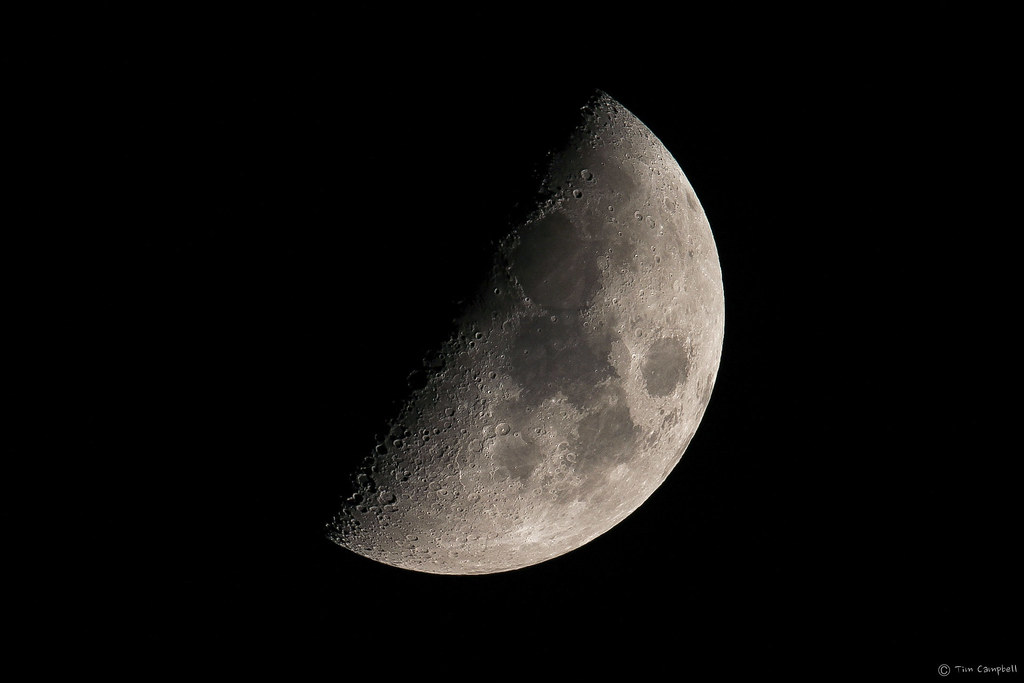
First Quarter Moon by
Tim Campbell, on Flickr
With your 300mm the moon wont be as large. My scope was giving me an 1100mm focal length and I did crop in just a tiny bit (a 1500mm focal length would have filled the frame.) You should still capture some nice detail.




![[No title]](/data/xfmg/thumbnail/42/42061-9f4eb186c434652d6587c8bcdde59502.jpg?1734176463)
![[No title]](/data/xfmg/thumbnail/31/31706-3e429b21053f11072ed2e5b37c019073.jpg?1734160380)