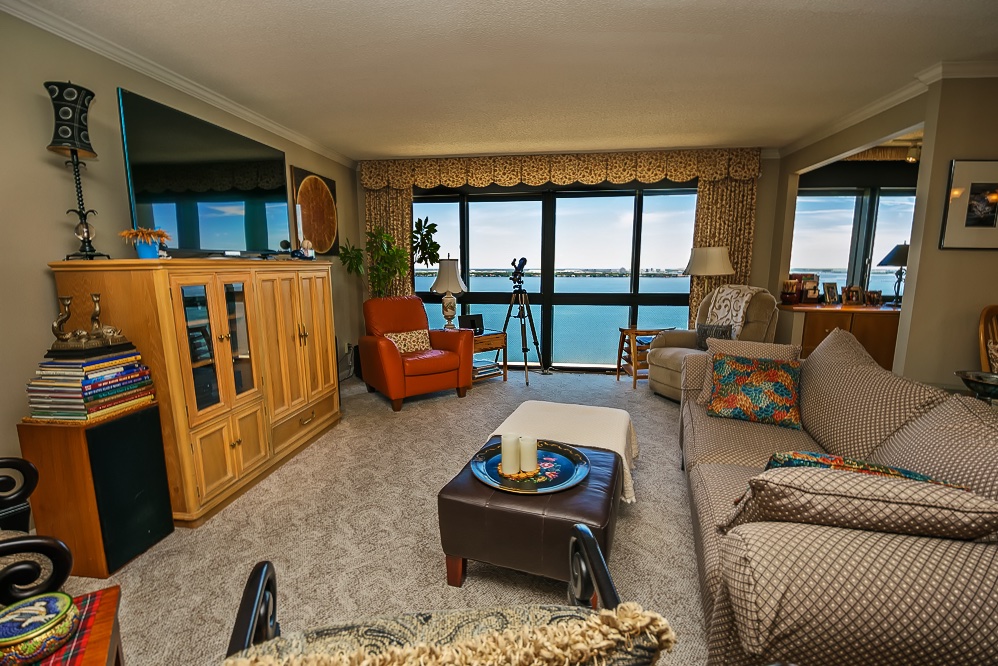
How do I make the camera expose for the outside of the house, and then the flash lights the inside?
When I was taking this photo, I moved the little box over to the outside area, hoping it would expose for that, but then as you can see...it didn't.
Its too far gone to bring back those highlights in post...so this photo is shot...however I would like to know for next time.
Also this is shot at ISO 800, and I like to shoot my real estate photos at ISO 100, but when I put the camera in A mode and change it to ISO 100, the flash goes off, but the photo is still too dark...I am guessing that has to do with the shutter speed?
All I know is, this house has a water and golf course view, and I totally ruined showing that.
View attachment 98070
OK, I don't have every answer you need but let's start with this one sentence, "
All I know is, this house has a water and golf course view, and I totally ruined showing that."
I assume you wanted to show the view through the large window. At the time of day and under the bright sunlight conditions you selected to take this photo, it's almost impossible to get the interior properly exposed and have the outdoor view also be properly exposed. It's a basic problem which has been discussed on photography forums over and over; your eye can perceive greater dynamic range than your camera can capture in one single shot. There are several answers to this. Don't shoot the interior when you include the bright sunlit window in full sunlight, shoot later in the day when the sunlight has moved away from the window. Shoot in Jpeg and have the exposure/dynamic range/shadow compensation circuits engaged. Shoot with your tripod and use the HDR capacity of your camera to combine several exposures into one complete image. I think I might have shot the interior with the curtains drawn or waited for dusk if I wanted to try for a shot with the view. Then you could show the view from the interior through the window and only include a bit of the interior. Or, best yet, don't show the view through the window, show it from just outside the window. But trying to cover such large differences in lighting will be difficult if not impossible for any camera.
Are you simply a photographer? Or, are you also a salesperson?
"Yes, but the client was standing right behind me and I didn't know WHAT settings to change on the camera, and I didn't want to stand there and tinker with things and take 27 photos of the same view."
No need to take 27 photos. But, if you're a salesperson, you surely must know how to make lemonade out of lemons. You started off wrong by trying to cover too much dynamic range. You could have explained the situation to the client or you could have scheduled a different time. You could have captured the shots required in just a few well planned shots. Is the client paying you to be a photographer? Or, an agent? Your regular photographer was out sick and you are doing this yourself but you might want the photog to come back and touch up some shots. Make the client feel at ease but don't allow yourself to get bothered by the client. That's sort of Sales 101. I'm sorry but, if the client gets you that rattled, you may have chosen the wrong profession. Walk around and shoot your head off. It's a digital camera and shots are basically free. Tell the client you like to have lots of shots to pick from. C'mon, sell yourself!
"Also this is shot at ISO 800, and I like to shoot my real estate photos at ISO 100, but when I put the camera in A mode and change it to ISO 100, the flash goes off, but the photo is still too dark...I am guessing that has to do with the shutter speed?"
I don't think you're doing a good job of understanding your camera. If you put it in "Auto" mode, it makes all the decisions. But the camera still can't overcome the large dynamic range issue. Unless you are using a shooting mode where you absolutely control the ISO, the shutter speed and the aperture, the camera will make its best attempt at producing a well exposed image. You're simply asking the camera to do too much. But why take your photos at 100 ISO? Because you've read that's the "best" ISO? The "best" ISO is the one that gets the shot you want properly exposed. If that is 100 or 3200, you have to use the exposure that gets the shot. You have a digital camera, ISO is not that important. Don't stick to 100 ISO if the camera needs greater light sensitivity. How large are your images going to be when printed? If you are producing the average real estate brochure, you're not taking fine art photos. The shots will be tiny and tiny images don't show ISO noise.
I think, if this is now your job to take photos of the houses you should do two things. OK, three. First, sit down with your camera and the owner's manual one night and really get a grasp on how you camera operates and the features it offers to assist you in difficult shooting situations. Second, take a short course in photography. Most local camera shops offer a weekend course which will give you a better grasp of how the features actually work to your benefit. Then, relax and act relaxed in front of the client. If the client perceives you to be at ease, they will have confidence you can actually sell their house. Don't call the "little box" you moved the "little box". There's a name for it and a reason to use it or move it. You really need to understand how your camera works. And what it cannot do. It can't do what you wanted it to do in this particular shot unless you help it help you.



 condo-1
 If you have lightroom you can correct the lens distortion also with the adjustments suggested above.


![[No title]](/data/xfmg/thumbnail/37/37605-90c8efaef5b7d1f52d4bf8e7dfd33673.jpg?1734170732)
![[No title]](/data/xfmg/thumbnail/37/37604-7ad625e983f92f880eb65a264eeef5e4.jpg?1734170732)

![[No title]](/data/xfmg/thumbnail/39/39497-93752210dd49247220721e5ac8c61245.jpg?1734173613)