I will now shoot very confidently with Noiseware at ISO 3200.
Though Noiseware does remove a lot of the grain, it is also removing a ton of detail when over-used at the higher settings. In facial shots, it will give them that plasticy or fuzzy feel. This is why it is so important you nail the exposure. All your shown shots are still always badly underexposed. There will be LESS noise in the picture if you start nailing the exposure in camera over depending on PPing to correct for user level errors.
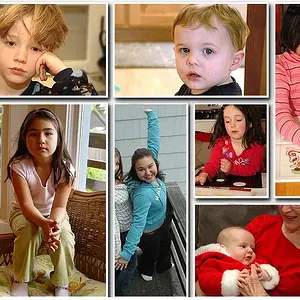
The Santa shots also had a severe colourcast. Your WB was quite far off. The beard looks orange, not white and the hat looks more black than red.

It could have come closer looking something like this:
Not having the original to work with, one was very limited in the amount of correction possible, but you get the idea.
The consistent underexposure leads me to ask you... are you even looking at the camera meter? If yes, it could be your camera has an issue. If not, it could be that you are not paying attention to a critical tool.
Ferrari, here is an ISO 3200 Ferrari for you (lol)... with NO post processing other than added sharpening and conversion from RAW to JPG. This area of the car show was OBVIOUSLY very dark and did indeed need ISO 3200 to get a minimum of 1/30th shutter speed (any less and I could start to introduce motion blur due to camera motion). I could have opened up the aperture, but that would have reduced my DOF, making the red Ferrari behind it blurry, which I did not want.
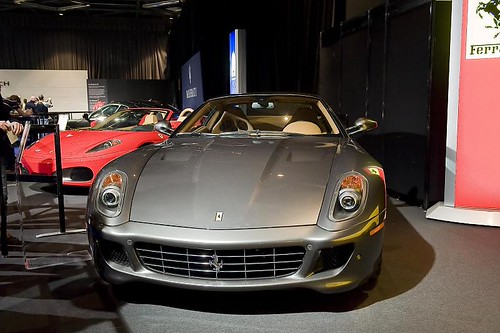
Note the top right B&W Ferrari sign... the white looks white and black looks black, neither look grey (as it would, if the when the exposure compensation was incorrect), details are clear and the exposure is good... not underexposed, and no blown highlights either. This is the goal you are aiming for. Now, your camera won't be able to touch this level of detail, but thats not the point. You have to concentrate on proper exposures to minimize noise and then practice with and get to know Noiseware. Use the most minimal settings to preserve detail as every bit helps.
Now, I know you were practicing with higher ISO settings on the Santa, but when they said it was a flat picture, they meant that the lighting across the scene was uniform and boring. It has nothing to do with your tests, but it does make for good info for you in the future. Sometimes extra flash is important, but for what you are now discussing, it is not possible nor even a good idea. The last thing you want to do is give some poor cheerleader at the top of a 3-tier pyramid a face full of full power flash from 6-feet away at a game. Not only would you be endangering her, at that point, you would also likely be escorted out.
As a final note, be aware that the higher up the ISO scale that you go, saturation and contrast drops, dynamic range drops (rather drastically in your case), detail is lost and more PPing work is required. In the end, understanding how your camera works, what are it's limitations and what are the consequences of higher ISO over say, fast glass or supplementary lighting are all part of the photography equation.



![[No title]](/data/xfmg/thumbnail/38/38720-f0f83c1b09a42065eefec8923841d54d.jpg?1734172597)