It's all about light...getting the amount of light you need, in the time period allotted, and the sensor as 'sensitive' as needed. More specifcally, it's the photography exposure triangle...aperture, shutter speed and ISO speed.
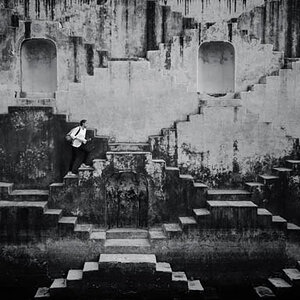
Although there are many possible combinations of the parts of the triangle that will produce a 'correct exposure', deciding what to increase with offsetting decrease(s) in the other 1 or 2 to get the picture you want is a matter of tradeoffs. Which of the three settings are 'required'...say shutter speed 1/125th or faster to capture human subjects at walking speed or slower without a blur. But sometimes 1/200th might be needed to completely 'freeze' them if walking fast with swinging arms. But to use that shutter speed and still get a good exposure will require either increases in aperture size (f-numbers -they are actually 1/fractions, with the 1/ part omitted - and smaller numbers are larger aperture sizes) and/or increasing the ISO speed (sensitivity). Increasing the aperture size results in a 'thinner' depth of field. Beyond that, things will be increasingly blurred. See
Understanding Depth of Field in Photography for a good DOF tutorial. Increasing the ISO speed, the speed at which the camera sensor 'reacts' (records) the incoming light works to a point. But above, say, ISO 1600 might result in numerous small colored dots in the resultant picture, particularly in the darker areas. That's called 'noise'. While in-camera software will automatically correct some or all of the noise, at some point, it can't correct it all without losing some sharpness.
So, it comes down to tradeoffs. When shooting in manual mode, I typically think of what setting is required to get my shot, and what compromises on the other two am I willing to make to get that shot. Many times, like outside on a sunny day, there's still a lot of leeway in the other two settings and still get a good shot...good DOF and slow enough ISO to not have any noticable noise.
But don't think you HAVE to shoot in manual mode. "A" is a good starting point, but when the camera doesn't automatically produce the desired exposure (too slow a shutter speed causing subject blurring indoors is a common "A" problem), then it's time to start learning to use the P setting (I think that's what it's called on a Nikon) where you can make a setting or two, and the camera will automatically determine the other(s) when the picture is taken. Then there's the time when you might want to photograph race cars, or a high speed toddler running around. That's when you'll want to force the camera to lock in a fast-enough shutter speed like 1/500 to stop the motion by using Tv mode. And on and on.
A couple of months ago, someone here coined the phrase 'acceptable compromise' when deciding what settings to use on their camera. I can't think of a better description. What are you willing to 'trade' to get what you want?













![[No title]](/data/xfmg/thumbnail/42/42064-76de02ee1a248037351c52c414af9bab.jpg?1734176464)