I looked at your flickr and you got great macro shots. Can you tell us what your setup is like for macros and what you use for flash? I just recently delved into macro so trying to pick up as much tips and tricks as possible.
Thanks! First off Ive looked at some of your as well and your already doing some great stuff. Im not sure anything I'm doing or using is any better than what you are already. Mostly I think it just comes down to more repetition and refining what you are already doing. I'm sure you know that.
Im still continuing to experiment with new methods gear and I change things up a lot. I have not been at this that long myself so I have yet to really focus on any one method or set of gear.
For live subjects I started with an APSC camera and a 100mm 1:1 macro lens using a standard speed light and a 4"x6" Vello diffuser. I still get some of the best results from this type of setup and find that going out early in the morning just after the sunrise is best not just for lighting but because most of the insects you happen upon are cold and tend to not move very much. This not only makes them less skittish but also allows for opportunities to take multiple shots that can be stacked together for deeper DOF. Im also using the the Canon MP-E 65mm 1-5x macro which is super nice for super high magnification but also very tricky to hand hold above 2x so I mostly use for studio staged stuff like the one in this thread.
I have also tried using a ring flash, the cheap one that Yongnuo makes. It works ok but often results in very flat images and produces harsh light and stopped using it all together. I went to the ultra expensive twin light flash system that both Canon and Nikon offer that mounts similar to a ring flash and found it to be only so so as well. Again very harsh light and by the time you rig up some sort of diffuser you have lost many of the advantages a flash like that offers that made it attractive in the first place.
Most of the macro pics on my flicker page were a result of the same setup with some variation of flash. I think all the best ones where just using a speed light and a cheap Vello diffuser. I recently sold off my apsc camera so Im using full frame for everything at the moment but to be honest for me macro is one area where I prefer crop sensor over full frame.
I am currently acquiring some new gear for a technique that dosnt use any flash at all only natural light. This method I have seen some refer to as the "fast" method or "pull" method and from what I've seen produces the very best results for deep stacking live subjects but to be honest I'm not really sure it has an official name. It consists of a camera with a very fast frame rate of 10fps or higher a rail system attached to the camera with a slider tube kind of like a trombone and a larger 12-16" diffuser attached to the camera or rail from one side. Tough to visualize I know. The idea is that you grip the flower stick or whatever that has the insect on it with the the thumb and index finger and rest the middle finger or hand on the slider. With the diffusers angled at the sun or light source you pull the subject through the DOF while firing off as many frames per second as possible. Assuming you have a live subjects that cooperating fairly well or is at least still enough you can achieve stacks of 50+ images of a live subject using only diffused natural light. The results I have seen are down right incredible.
Oh and I see you focus stack as well. Are these dead insects you stack or are you doing something to keep them from moving?
The extreme focus stacked images are usually with dead insects or ones that I first put to sleep with CO2 then staged and shot with a cognysis stack shot at high magnification. Some times I use a single strobe other times I use two or more speed lights shooting through a diffusion tube. I try to use live "sleeping" insects whenever possible because I don't like killing things and ones that have been dead for awhile already just look dead. Ive been learning how to restore dead insects to looking alive using ethanol to rehydrate and a combination of ammonia and Decon90 to clean and restore natural colors in the eye and exoskeletons. Still working on that process though I have not shot any like this yet but some of the best work I have ever seen is done this way.
Sorry, I know I really just rambled on here. Let me know if you have any other questions. Im no expert and am still learning myself but I'm happy toy share everything I know. If I have a specific image you want to know about just let me know what questions you have and Ill tell you what I did.


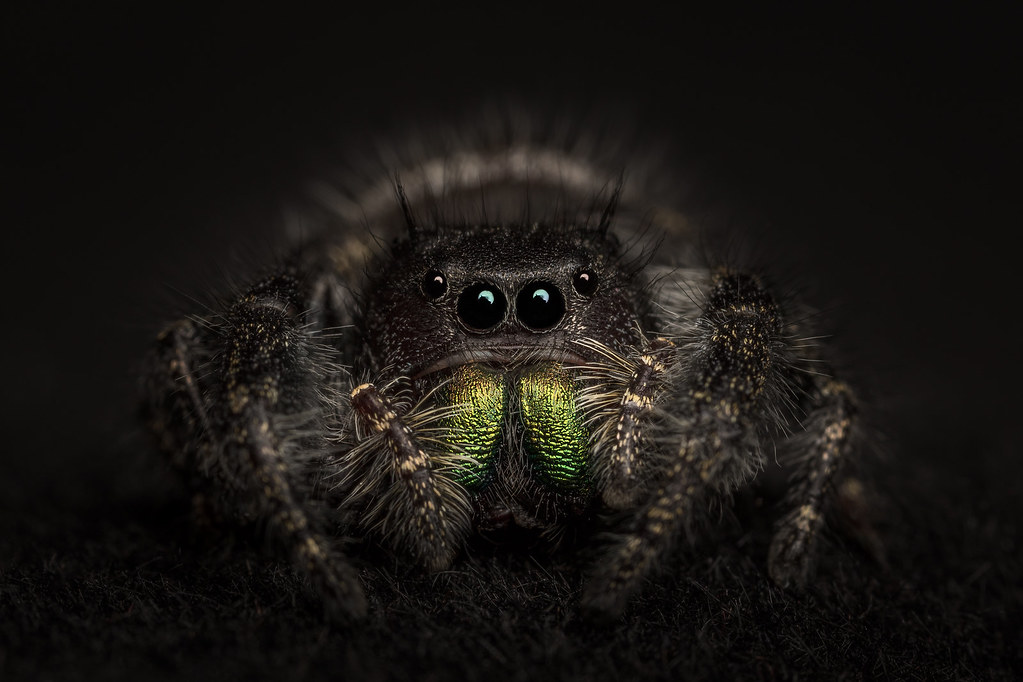 Regal Jumping Spider by Kristian Algra, on Flickr