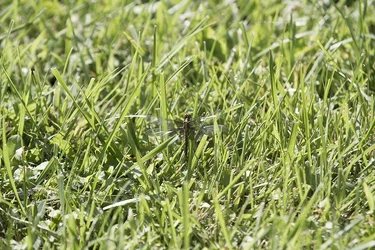
On a really complex target, like 259 blades of grass in a 3-square foot area...in contrasty lighting, MANY AF systems are going to have some trouble. Phase detect AF works best on high-contrast targets that have strong, distinct, linear detail, and boy howdy, a field full of grass is a nightmarishly confusing AF target!
Secondly, MOST AF brackets are just "generally accurate guidelines" on many cameras; the area covered by the AF brackets is often larger than the area the actual AF SENSOR is reading. On many cameras, the AF brackets in the viewfinder can have a small amount of "offset" from the actual area the AF sensor is "seeing", and so at times, the user might think he's aiming a laser-sighted sniper rifle...but he's actually aiming with a shotgun...there can be relatively large discrepancies with wide-angle lenses, or even with telephoto lengths.
One of the users here, I think it was Ron Evers, mentioned how he uses MANUAL focus when shooting songbirds in his trees...why? Same scenario as you have... a SMALL target, situated within a very complex, intricate, high-contrast background with loads of detail and strong, linear shapes...similar to the old needle in a haystack...
This might not really be "equipment error" so much as "equipment quirk", or "equipment characteristic under unusual circumstances". A very careful, tripod mounted test of the AF brackets, using something like a pencil jammed into a styrofoam block, can show you if the AF brackets have a slight bit of "offset". There was a good Thom Hogan article about this issue, discrepancy between AF brackets and ACTUAL AF sensor reading area, some years back.






![[No title]](/data/xfmg/thumbnail/40/40305-2fbdc00adce4fac5e62dccb3f6f9c633.jpg?1734174713)