What's new

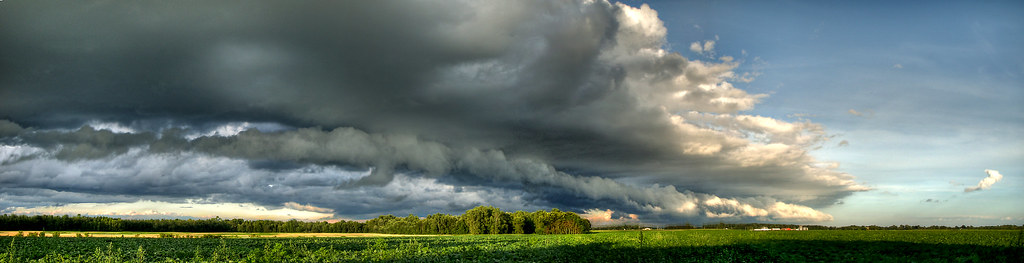
thunderstorm cc

Abby Rose

TPF Noob!
Joined
Feb 17, 2010
Messages
642
Reaction score
2
Location
Michigan!
Can others edit my Photos
Photos OK to edit
from waayyyy back in July. I've had the photos forever, just finally got around to processing them today.

It does have some noise issues. I'm not sure what to do about that... I tried to reduce it as much as I could. I wonder if it's my camera, because whenever I have that dark gray color in my photos it tends to be noisy. Hmm.

 
beautiful picture!
 
thank you. Anything you dislike?
 
in ps elements 8, yes.
 
It does have some noise issues. I'm not sure what to do about that... I tried to reduce it as much as I could. I wonder if it's my camera, because whenever I have that dark gray color in my photos it tends to be noisy. Hmm.
That's because of the way digital images work.

The darker a part of the image is the less light, or signal, there is.

Noise becomes more easily noticable when the signal to noise ratio is low.
 
Magic shot, I love thunderstorms but I've only had one for the whole of the year.
 
Abby, I love this one ! Frame it.
 
Noise becomes more easily noticable when the signal to noise ratio is low.

Wait, what? Can you rephrase this? I'm confused. I do understand the rest of what you said, though.

Everyone else, thanks. :)
 
Lovely picture with lots of atmosphere. I really like it!
 
Noise becomes more easily noticable when the signal to noise ratio is low.

Wait, what? Can you rephrase this? I'm confused. I do understand the rest of what you said, though.

Everyone else, thanks. :)

Different cameras handle lower light better. There are two types of noise:
- noise read from a captured scene
- noise created by the CCD. This noise is dependent on how closely packed the pixels are, the physical size of the sensor and the sensitivity of the sensor (effectively, the ISO)

When you have a good signal (good illumination) and low noise (limited dark areas, large CCD, lower pixels per inch) the signal to noise ratio is high (a good thing). When you have poor illumination (low light) and high noise (dark areas, small sensor and high ppi) you have a low SNR (bad thing).

Your Sony PS camera has a smaller sensor and likely bumps the ISO to compensate in lower light situations because you cannot swap out your lens for a faster lens (larger aperture). Hence, point and shoot cameras typically have a low signal to noise ratio. It might be easier to think of the ratio as a fraction so that when the bottom number is larger, the fraction is even smaller (further away from 1).
Signal = SNR
Noise
 
It was on aperture priority, I believe (that's what I normally shoot in), so could it still have bumped the iso without "permission"? I always leave the iso at the lowest setting.
 
Beautiful, I live in Florida we have a lot of boomers here but the past couple of years it's been quiet and not a lot has been going on. I was kind of hoping we would get a hurricane or some kind of major event while I have some decent gear to shoot it with.

Not bad for a bridge camera, image quality is there.
 
It was on aperture priority, I believe (that's what I normally shoot in), so could it still have bumped the iso without "permission"? I always leave the iso at the lowest setting.

Yes, cameras often have a limiting feature for how high the ISO can be automatically adjusted. I cannot read the exif data from your file, but you could check what the settings were for that image on your computer. Even with a low ISO, you still have to deal with the quality that a smaller sensor is going to provide. Don't be too worried until you see an actual print of the image. Sometimes we notice details on the computer screen that are not noticeable in a print and vice versa as well.
 
A camera's image sensor is composed of tiny little electric light sensors. When you open your shutter, millions (billions) of light photon hits each individual sensor and the sensor gets excited goes to work using electricty to record the details of that photon. The camera's computer then takes all of the information it got from each sensor and puts it together to form a picture.

Due the the simple nature of electricity, exciting each sensor causes noise for the other sensors. The "noise" being almost exactly what you think it is. It disturbs the other sensors near it. This causes the sensor to not record exactly what hit it resulting in a slightly off version of the original. For example if orange is represented by the number 5 and the light scale from dark to light is 1-10. If orange light strikes the image sensor, due to noise, it may see the value which should be 5,2 (pure orage, very light) it records it as 4.7, 2.6 or a little off ornage and not quite a light.

Think about it like a giant gymnasium where there are hundreds of artists standing in the gym with a piece of paper. The powers above open the roof of the gym and each artists goes to work drawing on the sheat of paper only what they see exactly over their head. As soon as the roof is removed, they all go to work.... the room becomes loud, arms start flailing around, people bump into each other and not every artist is able to draw exactly what they saw. P&S and bridge cameras use a smaller gym, fewer artists, and they are all packed closer together, so its much more crowded and there is much more noise. DSLR's the gym is large, they have more artists, and they are all spaced further apart. This is why noise is inherently worse on point and shoots and bridge cameras then DSLR's

Now enter ISO.... ISO is basically an electronic amplifier. In order to make a picture better exposed you bump up the ISO, which literally amplifies the signal. So if a sensor records an light orange (a number 5) doubling the ISO would result in an image of 10. Now consider all of the pixels doing the same thing next to each other. If all of the pixels were recorded perfectly you would have an area where it would all look the same 5,5,5,5... a nice and smothe orange, if you amplify by doubling it 10,10,10,10 you still have a nice smooth orange. However, as we already mentioned, there is natural noise, so at your lowest ISO the image would be recorded at 4, 5, 5, 4, 6.... all realtivly the same and all looking the relativly the same.... but if you doublt the ISO and amplify the image you double the values and you get 8, 10, 10, 8, 12... instead of only being 1 number off, they are now two... .jack your ISO from 100 to 1600, doubling 4 times.. your numbers go to 16, 20, 20 , 16, 24. Now the numbers are way off and you can notice an obvious difference between the individual pixels.

Maybe this helps to make more sense... maybe it makes it more difficult. But it does explain why you are seeing the noise in your gray areas with your bridge camera.

 

Create an account or login to comment

You must be a member in order to leave a comment

Create account

Create an account on our community. It's easy!

Log in

Already have an account? Log in here.

Back
Top Bottom