What's new

What the HECK just happened?

It depends on how lout the pop was. If it was just a little *pop*, than probably flash tube. If it was LOUD and it doesn't start up anymore, capacitor.


Compare this to when power packs explode. I've seen a Speedo pack blow a capacitor, it sounds like a gunshot and sparks flew out from it.
 
Capacitors work off smoke so whenever you let the smoke out, they don't work anymore. If you can get the smoke back in there then it'll work again but I'm guessing you let all the smoke get away.
 
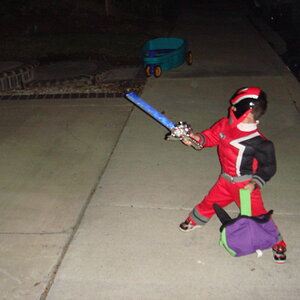
Hahaha... Well I will light a fire and try to catch the smoke again! I contacted the place I bought it and am HOPING there is a 1 year manufacturers warranty bc I've had it about 6 mo. To answer other questions, I do not have an adaptor bc the guy who sold it to me said it works directly with my hotshoe. It was a very loud pop, not a small one, and of course I was taking a pic when it happened so my baby has an extremely startled look on his face haha (but not well lit!).

You guys have been helpful but I'm still mystified!! How did I do this? Was it user error or a faulty flash? I just want to avoid doing it again.
 
runnergirl said:
Hahaha... Well I will light a fire and try to catch the smoke again! I contacted the place I bought it and am HOPING there is a 1 year manufacturers warranty bc I've had it about 6 mo. To answer other questions, I do not have an adaptor bc the guy who sold it to me said it works directly with my hotshoe. It was a very loud pop, not a small one, and of course I was taking a pic when it happened so my baby has an extremely startled look on his face haha (but not well lit!).

You guys have been helpful but I'm still mystified!! How did I do this? Was it user error or a faulty flash? I just want to avoid doing it again.

Oh and whoever asked what happens when I turn it off then on...no noise or anything. Ironically the "ready" light still turns on.
 
It wasn't your fault, the quality of the build of your flash is in question here, the Vivitar flashes these days aren't all that good, they used to be good but no longer held in high regard. If you do send it in and get it fixed and it happens again, I highly recommend to just get a different brand, if you get third party, try Yongnuo, they make some pretty good flashes, they make flashes for Canon Primarily and Nikon as well.
 
Oh, also, are you using it on the camera's hot-shoe ? or with a cord on a grip ? I needed to buy a special adapter to use my 283 directly on the camera's hot shoe. I was told that without the adapter there could be issues such as the one you described.

If this is true, it's a little scary as it might imply that their is no physical isolation between the flash and the body. Typically with flashes newer than 1965ish, the high voltage coil trigger is isolated with a type of "optical switch" from the low voltage shutter trigger so that there is no chance of the high voltage side running back down through the camera.

Old electronic studio flashes actually used the 250v+ coil trigger directly through the sync cable ... yeeha!
 
It wasn't your fault, the quality of the build of your flash is in question here, the Vivitar flashes these days aren't all that good, they used to be good but no longer held in high regard. If you do send it in and get it fixed and it happens again, I highly recommend to just get a different brand, if you get third party, try Yongnuo, they make some pretty good flashes, they make flashes for Canon Primarily and Nikon as well.
That, and/or just a random component failure. Even if the general quality of the unit is okay, they probably still by the capacitors from "People's Component Factory #6, Shanghai" and you apparently got a bad. I hope you can get warranty satisfaction!
 
I used the inexpensive Vivitar flash units. They are inexpensive because they use less expensive materials, less skilled labor, and less QA than more expensive flash units.

At one point I had 14 of the newer 285HV's and I used the snot out of them, but took care of them too. None failed.

Lots of other people use Vivitar flash units and we don't often hear of anyone having trouble with them.

Even camera maker $500 flash units sometimes fail, so if one of my $85 285HVs had failed, I wouldn't have been upset at all.

I give the current Vivitar flash units the same regard I gave the older version inexpensive Vivitar flash units.
 
I bought it new a few months ago. This is the second time I used it. I think I took a couple shots in rapid succession right before it happened. Seriously shouldn't it have some built in protection that if you shoot a little too fast it won't fire??
Do you know about capacitor 'forming'? Did you know you need to remove the batteries if a flash unit won't be used for a couple of weeks?

The flash unit likely uses an electrolytic main flash capacitor(s):

Capacitor - Wikipedia, the free encyclopedia
Electrolytic failure from disuse

Electrolytic capacitors are conditioned when manufactured by applying a voltage sufficient to initiate the proper internal chemical state. This state is maintained by regular use of the equipment. If a system using electrolytic capacitors is disused for a long period of time it can lose its conditioning, and will generally fail with a short circuit when next operated, permanently damaging the capacitor.....

When a hot shoe flash unit has not been used in several weeks, the main capacitors undergo some chemical changes and need to be 're-formed'. That is done by firing the flash unit several times (5 or so times) to discharge/re-charge the capacitors.
 
Vivitar had a big issue with a batch about 2 years ago where about half of the ones produced were faulty. Maybe it's a left over?
 
KmH said:
Do you know about capacitor 'forming'? Did you know you need to remove the batteries if a flash unit won't be used for a couple of weeks?

The flash unit likely uses an electrolytic main flash capacitor(s):


When a hot shoe flash unit has not been used in several weeks, the main capacitors undergo some chemical changes and need to be 're-formed'. That is done by firing the flash unit several times (5 or so times) to discharge/re-charge the capacitors.

I did not know any of this... Maybe I should take a photography class to learn how else not to blow up my cheap equipment :(
 
The first law of electronics.. if you let the blue smoke out, throw it out.

Given how a cap can be less than $50 to repair, and a flash bulb less than $10, why would you be so quick to throw it out?

It's like plumbing. When you have a leak in the house you replace the leaky part you don't get the entire plumbing redone. :)

When a hot shoe flash unit has not been used in several weeks, the main capacitors undergo some chemical changes and need to be 're-formed'. That is done by firing the flash unit several times (5 or so times) to discharge/re-charge the capacitors.[/FONT][/COLOR]

Err these types of chemical changes happen over a matter of years not a matter of weeks.
 
Well I have to say, I emailed the place I got it from to see if there is a manufacturer's warranty, and they are awesome. He told me he will just replace the flash and for me to send it to him and he'll send a new one. The website was cameracronies.com and they have had really good customer service on multiple occasions!

So, problem solved, I will try not to explode the next one!
 

Create an account or login to comment

You must be a member in order to leave a comment

Create account

Create an account on our community. It's easy!

Log in

Already have an account? Log in here.

Back
Top Bottom