What's new

AI-Assisted Photography

Exactly. Getting enough people's attention lets them sell advertising. The actual content is just filler.
It's so exhausting. Also I just wanted to be clear, there was no disrespect intended.
 
If we are talking about AI tools in editing programs here, I can say that I use some of those tools, notably the selection/masking tools and the remove/replace functions in Photoshop, most extensively. When straightening an image, I will now often use Generative Expand rather than cropping off the edges as I would have had to do before. Distraction removal using AI is faster and often more accurate than doing it manually, and if it is appropriate to the image, I will use that. I also use AI noise removal in Camera Raw, and occasionally Topaz, on many images.

I don't usually generate backgrounds; I would still rather use stock photos. When I have used Generative AI word online to create a background to match perspective, I was usually unhappy with the quality. As the realism factor improves, that may change, but I don't see myself subscribing to premium features that I will use only occasionally.
Many photographers use AI to speed up editing, like noise reduction, color correction, and upscaling, or to explore creative ideas such as lighting simulations and background replacements. AI can also help with organizing and culling large photo libraries, generating concept visuals, or producing multiple versions of an image for review. Most see it as a tool to enhance workflow and creativity, not replace traditional photography skills.
 
Maybe the essential question is, "Was the final image first created in the photographer's mind, or, was it created only by the tools used to make it?"
Maybe, if the photograph I show you is what I had in mind before I took it, then it matters not if I used an Olympus Pen E-PL10, or a camera obscura, or an Etch-A-Sketch with an A.I. lens.
 
Last edited:
Maybe the essential question is, "Was the final image first created in the photographer's mind, or, was it created only by the tools used to make it?"
Maybe, if the photograph I show you is what I had in mind before I took it, then it matters not if I used an Olympus Pen E-PL10, or a camera obscura, or an Etch-A-Sketch with an A.I. lens.
Well, it matters because photography was mainly considered capturing a moment in God's time in the real world as opposed to an artist painting what he sees in his mind. The tools in how its presented in the photographer's mind include angle of view, emulsion selection if film, DOF, lighting such as magic hour, magnification, composition, etc. Mixing photos taken in different places or times, cloning, etc, makes us like a painter not a photographer.
 
Mixing photos taken in different places or times, cloning, etc, makes us like a painter not a photographer.
And I see no real conflict there, if the components are all photographic images, recorded by a photographic device.

On the other hand, if I have a concept in my mind and go to my neighbor, the painter, and say, "I have this vision, now paint it for me, and I'll come back later and sign it," I don't see that as legitimate, since there is no craft involved on your part. Photography, painting, sculpture, et al, all involve craft, and having an idea is only preliminary to creating a work of art.
 
Mixing photos taken in different places or times, cloning, etc, makes us like a painter not a photographer.

True, it's like creating collages from magazine clippings and snippets. You use photo's (from someone else), to create something new. And perhaps add other layers of paint and drawings, combining stuff.
You're still creating things, which is good, but don't call it 'photography'.
 
And I see no real conflict there, if the components are all photographic images, recorded by a photographic device.

On the other hand, if I have a concept in my mind and go to my neighbor, the painter, and say, "I have this vision, now paint it for me, and I'll come back later and sign it," I don't see that as legitimate, since there is no craft involved on your part. Photography, painting, sculpture, et al, all involve craft, and having an idea is only preliminary to creating a work of art.
That's what AI does. It's taking pictures made by other photographers to create a photo according to your verbal or written description.
 
True, it's like creating collages from magazine clippings and snippets. You use photo's (from someone else), to create something new. And perhaps add other layers of paint and drawings, combining stuff.
You're still creating things, which is good, but don't call it 'photography'.
But this is taking other people's creations. That's what AI does when making a photo.

Which reminds me of the joke:

God is sitting in Heaven when a scientist says to Him, "Lord, we don't need you anymore. Science has finally figured out a way to create life out of nothing. In other words, we can now do what you did in the beginning."

"Oh, is that so? Tell me..." replies God.

"Well", says the scientist, "we can take dirt and form it into the likeness of you and breathe life into it, thus creating man."

"Well, that's interesting. Show Me."

So the scientist bends down to the earth and starts to mold the soil.

"Oh no, no, no..." interrupts God,

"Get your own dirt."
 
That's what AI does. It's taking pictures made by other photographers to create a photo according to .....
That's an interesting thought here. Because that's not only what AI does, it's what 99% of the people do.

Human behavior is largely shaped by observation. Our brains continuously form neural connections based on what we see around us, allowing us to adapt and align with the world we experience. In photography, this process becomes especially visible.

When people are exposed to thousands of images—different compositions, perspectives, and visual styles—the brain begins to internalize these patterns. Over time, these repeated visual inputs create a kind of mental reference library of what a “good” photo looks like.

As a result, when individuals start taking photos themselves, they often reproduce similar compositions and viewpoints. This is why many tourists capture nearly identical images of well-known landmarks: they are unconsciously guided by the countless photos they have already seen online or elsewhere. Most portrait photos lack creativity, most 'creative' ideas have already been made thousands of times.

In this sense, human image-making can resemble how artificial intelligence generates visuals. AI systems are trained on large datasets of existing images and learn to recreate patterns based on that input. Similarly, most people do not create images in a completely original way, but instead draw—often unconsciously—from the vast collection of visual examples they have previously encountered.

This does not mean creativity is absent, but rather that it is deeply influenced by prior exposure. True originality often begins when a person becomes aware of these patterns and consciously chooses to move beyond them.
Most photography by a human being only gives the impression that you're doing something new or creative, but actually, we're doing the same thing as AI does: making photos based on neural connections based on zillions of visual experiences we've seen before.

The way AI works is largely how our brain works, once you're aware of that, you'll learn more about your brain while practicing with AI. ;)
 
ME: What is the main difference between how the human brain works and how A.I. works?

COPILOT: The **main difference** is this:
> **The human brain *experiences* the world; A.I. *models* it.**

Everything else is a consequence of that single divide.

### 🧠 **1. The human brain is biological, embodied, and self-organizing**
The brain is a living system built from **86 billion neurons**, each adapting through **electrochemical signals** and **neuroplasticity**. It learns from:
- sensation
- emotion
- memory
- social context
- bodily states

It generates **conscious experience**, imagination, intuition, and moral judgment. It is slow in raw computation but astonishingly **energy‑efficient** (≈20 watts).

### 🤖 **2. A.I. is mathematical, disembodied, and pattern‑driven**
A.I. systems are built from:
- algorithms
- weighted mathematical functions
- massive datasets
- silicon processors

They operate at **gigahertz speeds**, moving information almost instantly across hardware. They excel at:
- pattern recognition
- scale
- consistency
- speed

But they lack:
- intuition
- emotion
- common sense
- consciousness
- self‑generated meaning

They do not “understand” the world; they detect **statistical structure in data**.

### 🔍 **3. The deepest difference: origin of intelligence**
**Human intelligence evolved**—shaped by survival, bodies, senses, and social life.
**A.I. is engineered**—shaped by math, optimization, and data.

The brain’s intelligence is:
- grounded in lived experience
- shaped by emotion
- tied to a body
- capable of imagination beyond data

A.I.’s intelligence is:
- grounded in training data
- shaped by objective functions
- detached from embodiment
- unable to generate meaning on its own

### ⚡ **4. A useful synthesis**
If you strip away all the technical detail, the difference collapses to this:

- **The brain feels its way to understanding.**
- **A.I. calculates its way to output.**

One is experiential.
The other is computational.

 
The thing is that most people are not aware of the input of data we gathered in our brains during all the past years.
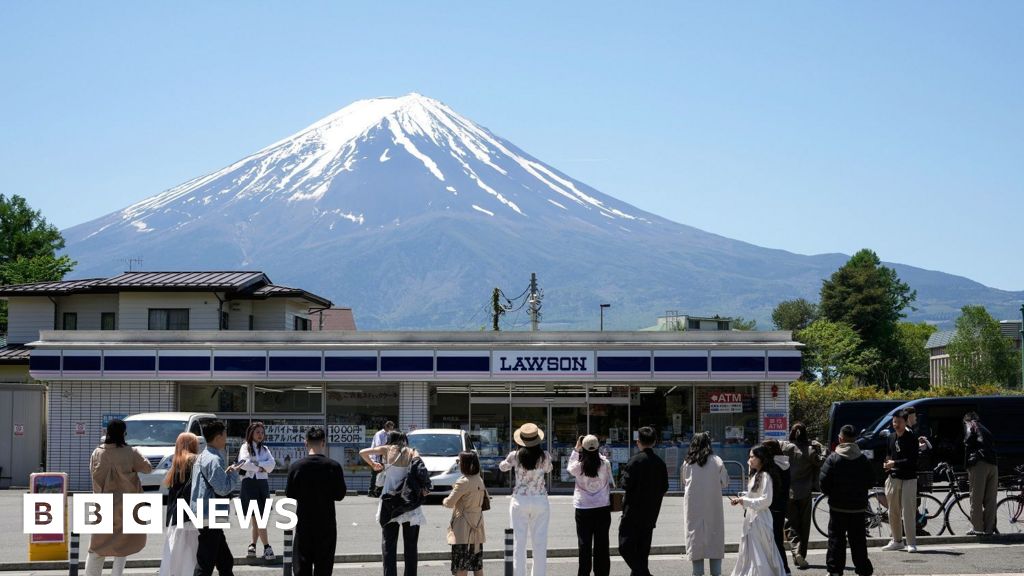
For example, most people know how Mount Fuji or the Eiffel Tower looks like, even when they haven't been to Japan or Paris.
They've seen it already hundreds of times before.
Funny fact is that most people are still amazed about these 2 things when they visit them, while they already know for years how it looks like.
When people are about to take a picture of it, they mostly do it the same way as how they've seen it and imagined it before. They want a composition of the Mount Fuji on the background, with cherry blossoms in front and an iconic temple aside.

And because tourists want to see what they already expect to see, they still try to go to that same spot, to shoot what millions of others already did before. Now they closed that spot because of too many people going there:

A good way is to try to detach yourself from your brain when making photos. Try to get into your emotional zone, which AI doesn't have, to get more original or creative.
 
How have you incorporated AI into your photography?
I use AI-powered editing tools for editing purposes, mostly online and simpler ones, like those that remove backgrounds like this one or ai photo restoration tools like this one for simpler repairing/cleaning of a picture (these are if you need examples). I don't mind doing everything myself but if there is an instrument that would complete mundane tasks faster why wouldn't I use it?

That being said, I never use AI for color correction or any generative AI whatsoever as this is the territory of creativity and I want to be creative on my own. Besides, it's not like AI can create something new, all it does is repeating what has already been done. It's just an instrument that can save your time and be used effectively, but people seem to give it too much credit in creative areas.
 
That's an interesting thought here. Because that's not only what AI does, it's what 99% of the people do.

Human behavior is largely shaped by observation. Our brains continuously form neural connections based on what we see around us, allowing us to adapt and align with the world we experience. In photography, this process becomes especially visible.

When people are exposed to thousands of images—different compositions, perspectives, and visual styles—the brain begins to internalize these patterns. Over time, these repeated visual inputs create a kind of mental reference library of what a “good” photo looks like.

As a result, when individuals start taking photos themselves, they often reproduce similar compositions and viewpoints. This is why many tourists capture nearly identical images of well-known landmarks: they are unconsciously guided by the countless photos they have already seen online or elsewhere. Most portrait photos lack creativity, most 'creative' ideas have already been made thousands of times.

In this sense, human image-making can resemble how artificial intelligence generates visuals. AI systems are trained on large datasets of existing images and learn to recreate patterns based on that input. Similarly, most people do not create images in a completely original way, but instead draw—often unconsciously—from the vast collection of visual examples they have previously encountered.

This does not mean creativity is absent, but rather that it is deeply influenced by prior exposure. True originality often begins when a person becomes aware of these patterns and consciously chooses to move beyond them.
Most photography by a human being only gives the impression that you're doing something new or creative, but actually, we're doing the same thing as AI does: making photos based on neural connections based on zillions of visual experiences we've seen before.

The way AI works is largely how our brain works, once you're aware of that, you'll learn more about your brain while practicing with AI. ;)
What AI does is not what people do with a camera. A photograph made with a camera captures real time, while AI is copying and reassembling previous photos. A photograph doesn't have to be creative or artistic to be a photo. A photograph can be a boring picture but it;s still a photograph of a moment in time never to be repeated in time or captured by anyone else exactly as it was. It's not a variation of someone else's photograph, as AI creates.
 

Create an account or login to comment

You must be a member in order to leave a comment

Create account

Create an account on our community. It's easy!

Log in

Already have an account? Log in here.

New Topics

Back
Top Bottom