What's new

Nikon 55~200 AFS

If my lights have to be placed in somewhere front of the subject (which I strongly suspect) , I will have to buy new soft boxes, because the front of the tent is open. If on the other hand the strobes can be placed to the side of the tent (front side) the tent would dissipate the light.
Honestly, this is the kind of thing that should be able to do intuitively. If the front of your subject is too dark, then obviously you need more light on the front.

So if you can't adapt the softboxes to mount your strobes, then I guess you will have to get different softboxes. The front of your tent is probably going to be open by default, so placing the strobes to the sides are not going to illuminate the fronts.
 
Sorry... i have to ask some questions, on chapter 4, because chapter 5 the author has moved out of subject.
I was all excited in the beginning of chapter 4, when I discovered that we must place our lights outside the family of angles (whenever possible) so as not to obtain direct reflections. The first thing that leaped to mind, was that every photographer, that uses an on camera flash is an idiot, because said flash is directly in the family of angles.
The author then continues to say that if we are forced to place the lights inside the family of angles, we should use a polarizing filter on the lens and on the light, however these should be avoided whenever possible. So far so good.
This immediately made me think, that placing strobes (That I have not bought yet, but will shortly) anywhere near the camera to the right or left of the camera is wrong, because they would be in the "forbidden" area and would lead to direct reflections from the leather bags. Naturally, the only logical option would be to place the strobes on the sides of the tent outside of the family of angles.
He then, gives an example of a black textured leather book, and explains that since the leather is textured, we cannot have the light come from the sides, but rather we need to capture the textures in the leather, so we have to place a large light inside the family of angles to capture texture. If my understanding is correct, we must choose between getting a good texture, but having hot spots? Or no hot spots, but no texture. Is there a compromise somewhere?
Thank you
 
The "large light" is large so it is not a hard light. It is also not the only light. I would set the other lights first and then adjust this one to bring out the texture. I would put off picking up any more camera stuff until you can consistently get good results with what you have.
 
Read this section again
image.webp


Then read the last paragraph of the chapter
 
Wow, thanks I will.
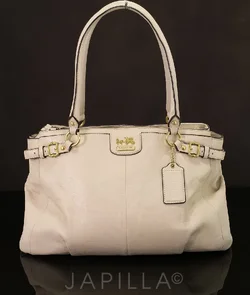
I tried taking shots of this bag on a white background, and it nearly made me vomit at how bad the picture was. So i changed to a dark background, and it looks a little better. I could swear that the light on the left is outside the family of angles, and yet I have a direct reflection. I am going to finish the book before I take any more pics. I was trying to bring the texture out, and the left light is supposed to do that...no such luck. No worries, some day I will figure it out.......
 

Attachments

  • 2b.webp
    2b.webp
    268.9 KB · Views: 166
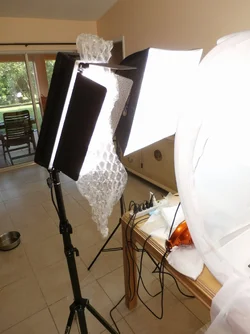
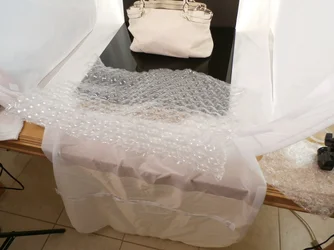
I tried something crazy, albeit totally unprofessional, and not aesthetically pleasing, it's working like a charm. The big bubble wrap, the heavy duty stuff. I placed it single and double layer in front of my lights. I cannot get a direct reflection on the leather, no matter where I place my lights (in or out of the family). I am now going to cut some more and equip all my soft boxes with this stuff
 

Attachments

  • P8050050.webp
    P8050050.webp
    126.7 KB · Views: 146
  • P8050051.webp
    P8050051.webp
    189 KB · Views: 139
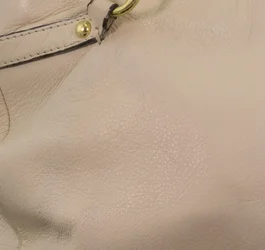
Yesterday, this area of the bag had huge direct reflections, now look with the bubble wrap how diffused it all becomes...I'm chuffed
 

Attachments

  • direct ref.webp
    direct ref.webp
    209.3 KB · Views: 133
If my understanding is correct, we must choose between getting a good texture, but having hot spots? Or no hot spots, but no texture. Is there a compromise somewhere?
I think you already know how to model texture, (or you should know) so while you're setting up your lights, you can concentrate on the texture, if that is what you wish.

I think if your modifier (diffuser) is large, making the light very soft, the "hot spots" would be very soft as well.

Not to worry then. When you order strobes, order large softboxes to go with them.
 
Now you're starting to work like a photographer who knows what he is doing.

Congratulations!
 
Diffusion with lighting is key
You're getting the hang of it

That's the problem with any type of bulb. They have hot spots and diffusion softens and distributes the light to minimize hot spots.
The more diffusion layers the better for what you're doing.

Keep reading the book.
 
The Reynolds wax paper is the culprit for giving me occasional weird color pixels. The bubble wrap does not. However the bubble wrap is quite translucent.
 
Sorry guys... have to ask this again so there is no confusion on my behalf.
When i focus in "A" on a corner of the bag (where the DOF starts).

You are mistaken. Depth of field does not start at the plane of focus. The plane of focus is about 1/3 of the way from start of the nearest point of acceptable focus to the furthest. About 2/3 of the depth of field is behind the plane of focus and 1/3 in front of it. None of your issues relate to depth of field. Stop worrying about it and improve your lighting and your post process.
 

Create an account or login to comment

You must be a member in order to leave a comment

Create account

Create an account on our community. It's easy!

Log in

Already have an account? Log in here.

Back
Top Bottom