What's new

Wedding question

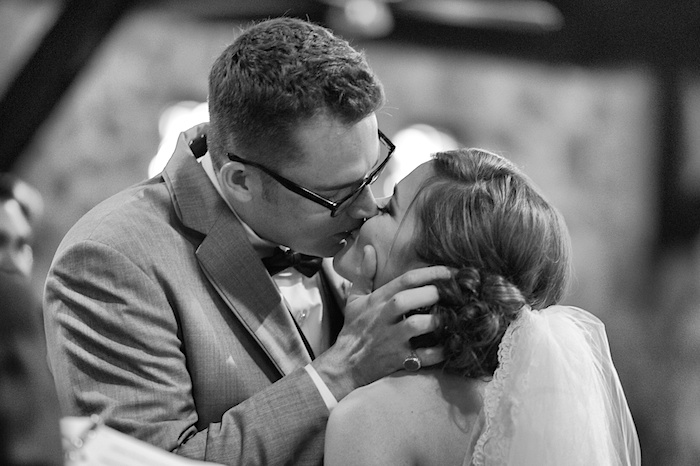
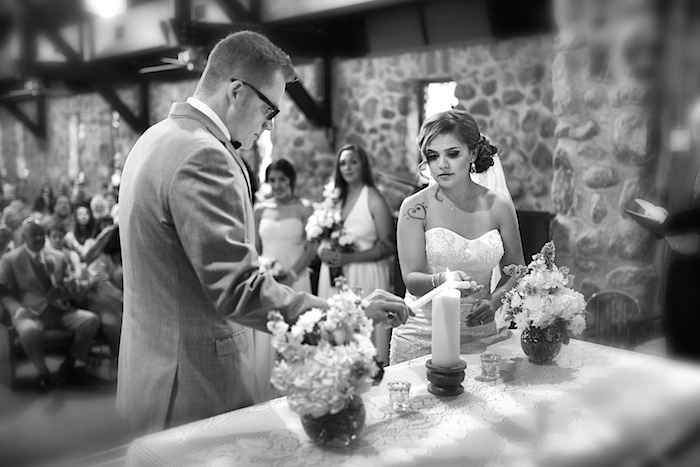
Ah . . . selective memory! I shot the close-ups at the altar with an 85mm, but I just looked at the original files, and my "tight" altar images were actually cropped by about 50% after the edit. I suppose I could've used the 70-200mm instead, but then I would've had to halve my shutter speed, and double my ISO (or, some combination thereof). I measured the ambient in the church, and if I remember correctly, there was only 0.5 footcandles present. Even though I shot RAW, these were converted to B+W because the ambient color temps were super weird, and very mixed (mercury-vapor, incandescent, daylight, candlelight):

Available-light altar images from my first wedding shoot:
wedsamples85-4.jpg

Nikon D3s + AF-S Nikkor 85mm f/1.4 [50% crop]; ISO: 2,000; f/1.4 @ 1/200th.
wedsamples35-4.jpg

Nikon D3s + Sigma 35mm f/1.4; ISO: 2,000; f/1.4 @ 1/200th.

So, I think fast lenses (in my case, f/1.4 primes) are pretty much a prerequisite for dimly lit interiors since most venues don't allow strobes during the actual ceremony (procession/recession, usually, yes). But in answer to your original question, aside from the ceremony coverage at the altar, my 24-120mm short-zoom (or, 24-70mm f/2.8, if that's what you own) was my "go-to" lens for the majority of the rest of event (as it is for my other non-wedding, flash-fired event shooting).
 
Last edited:
I shot my first wedding only a few months ago, and am about to shoot my second in a couple weeks. Here's the lenses I used:

• AF-S Nikkor 24-120mm f/4.0G VR on a flash-fired body (Nikon SB-800/SC-17 on a Newton rotating bracket, plus a Quantum Turbo battery).
• Sigma 35mm f/1.4 (used for available-light wide shots during the ceremony, and for the couple's full-length formals).
• AF-S Nikkor 85mm f/1.4G (used for available-light close-ups during the ceremony).
• Sigma 150mm f/2.8 OS (used for tight headshots in the bride's ready-room).

Now, you may be wondering if I'll change my lens line-up for my second wedding . . . and, actually, I think that original lens selection worked out pretty well. For that first wedding, in the bride's ready-room, I set up a Nikon SB-800/TT5 into a 45" Westcott soft-silver umbrella (the available-light level was very low, and also consisted of mixed color temps). I shot all the ready-room coverage with two primes: the Sigma 35mm f/1.4 and Sigma 150mm f/2.8 OS--each on its own FX body, each body with its own TT1 trigger, firing the same off-camera flash (for smaller spaces, I might switch the 150mm for an 85mm).

Now your approach will probably be different from mine, but I just really love these two Sigma lenses (they're kind of the only two lenses I shoot for personal work now). The 35mm f/1.4 is a great documentary focal length, and the 150mm f/2.8 OS is now my favorite portrait lens (plus, both lenses are super sharp). But many pro wedding shooters do just fine (and, shoot a lot), with only a 24-70mm f/2.8 as their primary event lens, so don't let my particular affinity for these fixed-focal length lenses divert you from benefitting from the speed and convenience a fast short-zoom offers (especially, if shooting with only a single body). Good luck!
 
Last edited:
Thank you for all the input! Also, her wedding is being held outside.
Sorry, I didn't see that. Oh well, forget about the part about f/1.4 lenses! Now you need to hone your fill-flash technique, and perhaps invest in some scrims (Westcott makes some excellent foldable, and aluminum-framed scrims).
 
Last edited:
But just to be clear... I have a few rules, and I suspect that I am not alone in my thinking on this topic. One rule is this: When someone asks for advice ... they should be prepared to listen to the answers provided -- whatever those answers happen to be and regardless of whether or not it's the answer you were hoping to hear.

I always love the advice TCampbell provides, but AMEN to this one in particular.


YES! I call the opposite of his advice "being an askhole."

I did a wedding one time with no experience. If I could go back, I'd have NEVER done it. Seriously, worst experience of my life. I was only beginning to learn how to shoot in manual and had no concept of proper exposure or really even composition. I did it free, for a friend, and we are no longer friends.

2016 - gives you a lot of time to learn. I would be networking with all the local pros the best I could and second or third shoot with them if they're willing. While any bride will tell you a wedding day is chaotic, the vendors and people running the wedding really get the full blown experience.

If you get paid for any second'ing gigs, I'd invest in some better glass or set up a lens-rental fund. Your zoom, if it's the one I'm thinking of, will not do well in low light (in fact, it's the same one I used for that horror show I mentioned above).
 
oh, I guess i totally forgot about the actual question the OP was asking....sorry 'bout that.

we actually have two sets of lenses that are used at pretty much every wedding.
my wife favors the 17-50 f/2.8 and 70-200 f/2.8, and I typically favor the 50mm f/1.4 and 85mm f/1.8 (sometimes if i have to do a lot of moving around i will use the 28-75 f/2.8)

but generally speaking, those are what we use the most lens wise.
 
2016 - gives you a lot of time to learn . . .

Yes, that is a long timeline. I started preparing to shoot weddings for about the same length of time. The first thing I did was to buy a second body. Then, I slowly built up a significant inventory of back-up lighting equipment (everything I own is now backed-up between 2x-4x-deep). Also, throughout this time, I attempted to simulate every type of lighting set-up I might encounter at a typical wedding--I especially concentrated on the most challenging lighting scenarios (e.g., bright daylight with the sun high in the sky, etc.).

There's a lot of lighting involved in most wedding photography, so mastering both fill-flash daylight exterior lighting, as well as interior lighting technique is important to becoming a well-rounded event photographer. I think in addition to asking questions on photo forums, I would invest in some good wedding photography books. There's quite a few on Amazon, and most are very well written, full of technical tips, practical advice and good creative ideas.
 
Last edited:
I shoot weddings from time to time, mostly for friends and not for profit. I use my Nikon D7000 and I use a 35mm f1.8 and a 50mm f1.8 for the available light stuff and my 16-85 f/3.5-5.6 for outside or with flash. When I need flash I use a Yongnuo 565ex. It is a good idea to have a backup camera body and flash incase something goes wrong and of course extra batteries, etc. Back in the day I used a Mamiya C330 TLR with an 80mm normal lens with a potato masher (big handle mounted flash). If need be I could do it all with the 35mm f/1.8 and a flash but, zooms make things easier. Be sure to make a list with the bride and groom of shots they want. There are lists available on the net of "must shoot wedding pictures" that can be helpful. More than anything I think you should use equipment you are as familiar with as the back of your hand. When shooting a wedding you have to take charge of the situation at times and organize and direct your setups so you can get things over with quickly so the bride and groom can get on to the reception etc. Fumbling around with unfamiliar equipment can really slow things down.
 
Last edited:
Just use what ever lenses you have since you're probably doing it for free anyway.
 

Create an account or login to comment

You must be a member in order to leave a comment

Create account

Create an account on our community. It's easy!

Log in

Already have an account? Log in here.

Back
Top Bottom