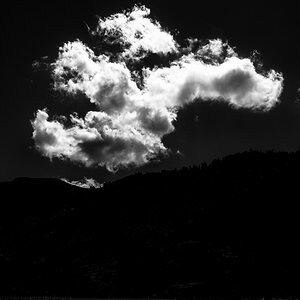
When the Moon is 'new' the side of the Moon facing Earth is not lit.
That can only happen when the Moon is very close to being on the line between us and the Sun, making it very difficult to photograph, and of course no stars would be visible because it would be daytime.
Each night past 'new' a little more of the side of the Moon facing Earth is lit, and the Moon is a little bit further from the Sun by about 52 minutes per day.
By lunation day 0.5, only 0.3% of the side of the moon facing Earth is lit and the Moon is still very close to the Sun.
The last New Moon (lunation 29.29 days, 0% illuminated) was on September 30, @ 10:59:38 here where I live.
New Britain is pretty close to the same latitude I am at, but adjust the times (time zone) for your longitude.
First quarter Moon (lunation 8.2 days, 50% illuminated) this month will be Saturday night Oct. 8, @ 23:55:38 my local time.
In New Britain, CT, on the 8th the Moon will cross the meridian - due south and the highest point in the sky that night the Moon will reach - at 17:35 PM.
Sunset in New Britain will be at about 6:21 PM.
Nautical twilight doesn't end until 7:21 PM, and astronomical twilight doesn't end until 7:53 PM. Until the Moon sets, the end of astronomical twilight is as dark as it can be where you are. Once the Moon sets it will be a little darker.
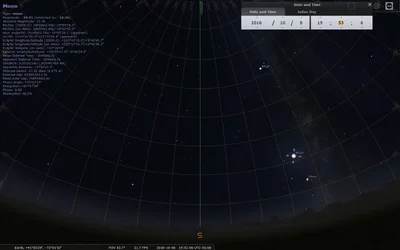
The Moon will be at azimuth 214° and an altitude of 21° above the SSW horizon at 7:53 PM in New Britain.
I used 2 free download software applications to determine the dates, times, and sky coordinates noted above for New Britain and my location:
Virtual Moon Atlas &
Stellarium
Attached Stellarium screen shot licensing:
The full sky milky way panorama is created by Axel Mellinger, University of Potsdam, Germany. Further information and more pictures available from
Axel Mellinger's Milky Way Panorama 2.0
License: permission given to "Modify and redistribute this image if proper credit to the original image is given."
And credit to Stellarium.org for the rest - per Stellarium creator/coordinator Fabien Chéreau.


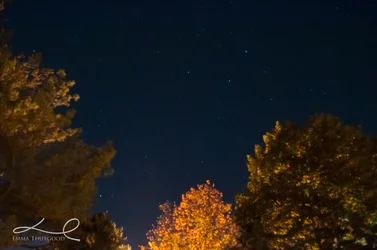
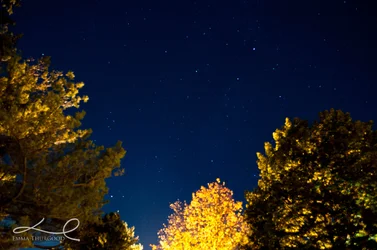
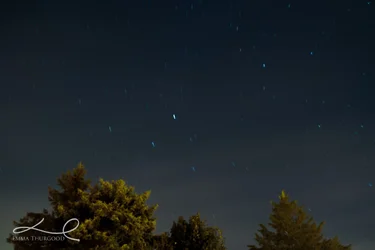
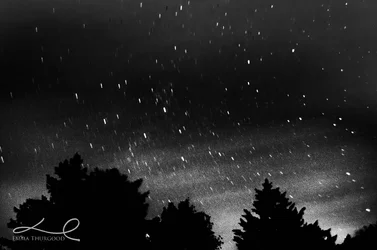
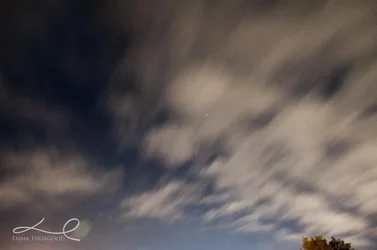




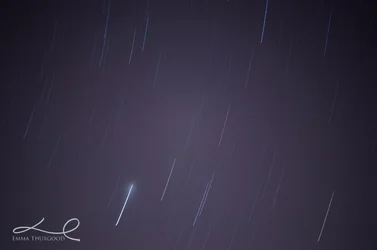
 . I then set my focus to infinity and I then turn on Liveview, find a very bright star and try and centre it in the Liveview screen on the back of my camera. I then use the "magnifier" and enlarge the image. The star may look like a blob or a round doughnut of sorts. I then adjust my focus, as necessary, until the star is a very small pinpoint or as small and as sharp as I can get it. In this situation, your lens should now be focused properly to capture sharp star trails. Some photographers I know, advocate the use of gaffer tape to hold the focus ring in place. Gaffer tape is recommended because it will not leave a gummy residue on your equipment.
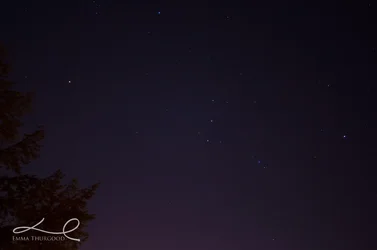
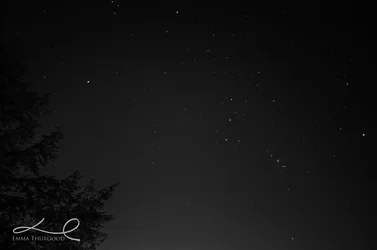
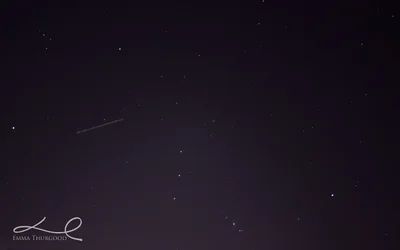
 These are from my back deck actually overlooking the light pollution from Hartford. I think that's why they all have a vignette look going on. But more than composition or quantity of stars I was concerned with trying to get the focus a little more nailed, and playing with techniques to figure it out. I'm also doing a lot more in editing to add color to the images with the tint and temp. I kind of like how I lucked out with the plane flying through Orion. It's like an arrow going through his heart.